Purified shilajit: what the word means and how to check a jar

A plain guide to one of the most used words on shilajit labels.
Purified shilajit is raw shilajit that has been dissolved, filtered and dried back into resin so that rock, soil and debris are removed. The word on its own proves nothing. Published lab work has found lead, arsenic and mercury in some shilajit samples, so the only real check is a batch lab report that names the lab and lists heavy-metal results.
Search for shilajit and almost every jar says purified. Some say pure, some say gold grade, some say lab tested. These words are not regulated terms, and they do not mean the same thing. This guide explains what purification does, what labs have found in shilajit, and how to read a jar before you pay for it. If you already know what to look for, you can go straight to our resin and its testing details.
What purified shilajit is
Shilajit is a dark, sticky resin that seeps from rock in high mountain ranges. A 2012 review in the International Journal of Alzheimer's Disease describes it as a substance found mainly in the Himalayas, formed over centuries as plant matter is broken down by microorganisms. The same review names fulvic acid as its main studied component.
In the mountains, that resin is mixed with stone, sand and plant fibre. You cannot sell it, or eat it, in that state. Purification usually means three steps. The raw material is dissolved in water. The liquid is filtered so that rock and debris stay behind. Then the filtered liquid is slowly concentrated until it becomes a soft resin again.
That is the whole idea. Purification removes what you can see. It does not, by itself, tell you anything about what you cannot see, such as dissolved metals. Those need a lab.
Raw, purified, extract: how they differ
Researchers handle these as different materials. A 2026 analytical study in the Journal of Chromatography A profiled shilajit raw material, extract and resin separately, measuring markers such as fulvic acid and a set of 14 elements in each. For a buyer, the practical differences look like this.
| Form | What it is | What to ask for |
|---|---|---|
| Raw shilajit | Rock-bound material as collected | Not sold as food; skip it |
| Purified resin | Dissolved, filtered, dried back to paste | Batch heavy-metal report |
| Dry extract | Resin dried to powder, often standardised | Fulvic acid % and metal report |
| Capsules or gummies | Extract mixed with other ingredients | Shilajit amount per serving |
Resin is the least processed of the forms you can buy. Capsules and gummies are convenient, but you are trusting a second set of ingredients and a smaller dose of shilajit per piece. We compare these trade-offs in detail in our resin vs capsules vs gummies guide.
Why purification matters: what labs have found
Shilajit forms in rock. Rock contains metals. So the question is never whether a sample contains minerals, but which ones and how much.
A 2024 review in Biological Trace Element Research pulled together the published data and reported around 65 metals across shilajit studies, including lead, arsenic, cadmium and mercury. Most reported levels sat below the WHO and FDA limits the authors used. A few studies found levels above them. The authors concluded that taking shilajit without knowing its metal levels is not safe.
A 2022 study in the same journal tested Indian and Pakistani shilajit with three lab methods. It reported lead, arsenic and mercury above permissible limits in the samples analysed.
This is not a shilajit-only problem. In a well-known JAMA study, researchers bought Ayurvedic medicines online and analysed 193 of them. 20.7% contained detectable lead, mercury or arsenic, and products made in the US were no cleaner than products made in India.
In Europe, the rules are clear. Maximum levels for lead, cadmium and mercury in food supplements have applied since July 2009, according to Germany's Federal Environment Ministry, and today sit in Commission Regulation (EU) 2023/915. A jar sold as a food supplement in the EU has to meet them. Testing is how a seller shows that it does.
How to check a jar before you buy
Our view is simple. A purity claim without a batch number and a named lab is marketing, not evidence. Here is the checklist we would use on any brand, including ours.
- A named, independent lab. "Third-party tested" with no lab name tells you nothing. Look for the lab by name.
- Heavy metals listed with numbers. Lead, cadmium, mercury and arsenic, each with a measured value and a unit such as mg/kg. A tick box is not a result.
- A batch or lot number that matches the jar. A report from an old batch says little about the one in your hand.
- Origin stated plainly. A region or mountain range, not just "ancient" or "wild".
- Fulvic acid stated as a percentage. It is the component researchers measure most, and a stated figure gives you something to compare.
- A proper food supplement label. A business name and address, a serving size and a best-before date.
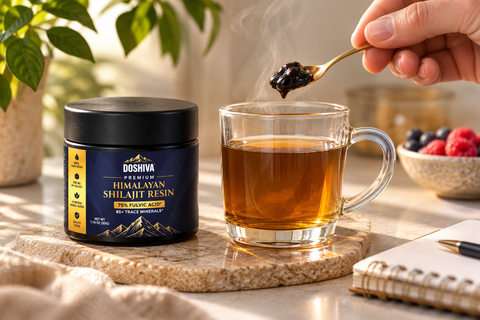
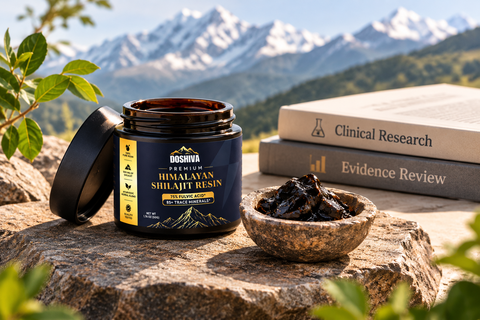
For reference, here is what we publish. Doshiva Shilajit Resin is a Himalayan-origin resin with 50% fulvic acid and 84+ trace minerals, heavy-metals tested by Eurofins. A 50 g jar costs EUR 49.95. If any of those details are missing from a jar you are looking at, ask the seller. A good one answers quickly.
Home tests: what they can and cannot tell you
Videos promise you can spot real shilajit with a flame, a glass of water or the warmth of your hand. These tests look at texture and how the resin dissolves. Some fakes may fail them. Some do not.
What no home test can do is measure lead or arsenic. Metals do not change the colour of warm water. They do not make resin melt faster. A sample can pass every kitchen test and still sit above the legal limit, which is why the lab report matters more than the trick. Use home tests for curiosity. Use the certificate for the decision.
Storing and using resin
Purified resin is stable when it is kept dry. Close the lid after each use, store the jar away from heat and direct sun, and use the spoon or scoop it came with rather than a wet one. In cold rooms it hardens. In warm rooms it softens. Both are normal.
Resin is usually taken dissolved in a warm drink. Follow the serving size printed on your jar. Shilajit has many names across Central Asia; if you have seen it sold as mumijo, our guide to mumijo and shilajit explains the overlap.
Frequently asked questions
Is purified shilajit the same as pure shilajit?
Not quite. Purified describes a process: the raw material was dissolved, filtered and dried. Pure is a marketing word that usually means nothing else was added. A product can be both, either or neither. Check the label and the lab report, not the adjective.
How can I tell if shilajit is real?
Texture and smell give you clues, but they are not proof. Ask for a recent certificate of analysis from a named lab, with heavy metals listed in numbers and a batch number that matches your jar.
What does lab tested mean on a shilajit label?
It should mean an independent lab measured contaminants in that batch. In practice, the phrase is used loosely. Unless you can see the lab's name and the measured values, read it as a claim rather than a result.
What is fulvic acid in shilajit?
Fulvic acid is the component researchers name most often when they study shilajit. Labels usually state it as a percentage of the resin. A stated figure lets you compare jars; a missing one is worth asking about.
How much does purified shilajit resin cost?
Prices vary widely by brand and size. Our 50 g jar of resin is EUR 49.95, with lower prices per jar in multi-jar bundles. If you prefer a chewable format, see Doshiva Himalayan Shilajit Gummies.
Does purified shilajit expire?
Your jar should carry a best-before date. Use that date, and keep the resin dry and sealed so it stays in good condition until then.
Pair with: Doshiva Shilajit Resin, Energy & Vitality, All products, Resin vs capsules vs gummies
Sources
- pubmed.ncbi.nlm.nih.gov/22482077/ (pubmed.ncbi.nlm.nih.gov)
- pubmed.ncbi.nlm.nih.gov/41330163/ (pubmed.ncbi.nlm.nih.gov)
- pubmed.ncbi.nlm.nih.gov/38393486/ (pubmed.ncbi.nlm.nih.gov)
- pubmed.ncbi.nlm.nih.gov/34800280/ (pubmed.ncbi.nlm.nih.gov)
- pubmed.ncbi.nlm.nih.gov/18728265/ (pubmed.ncbi.nlm.nih.gov)
- www.bundesumweltministerium.de/en/topics/health-chemicals/overview-health/overview-food... (bundesumweltministerium.de)
This article is for information only and is not medical advice. Food supplements should not be used as a substitute for a varied, balanced diet and a healthy lifestyle. Speak to your doctor before taking supplements if you are pregnant, breastfeeding, take medication or have a medical condition.