Shilajit Fulvic Acid: What the Percentage Really Means
Why shilajit labels say 15% or 60% fulvic acid, how test methods change the number, and what to ask before you trust a fulvic acid claim.

Why one shilajit label says 20% fulvic acid, another says 60%, and what to ask before you trust either number.
Shilajit fulvic acid is the compound most labels lead with, but the percentage you read depends heavily on how it was measured. Independent testing found fulvic acid ranging from 6.9 mg to 2,206 mg per serving across eight shilajit supplements, with resins far lower than capsule extracts. Treat a fulvic acid percentage as meaningful only when the brand names the lab and the test method.
Search for shilajit and fulvic acid and you will see numbers from 15% to 80% printed on jars, often with no explanation. This article explains what fulvic acid in shilajit actually is, why the figures disagree so much, and how to read a label without being misled. Our own Doshiva Shilajit Resin states 50% fulvic acid, so these questions apply to us too.
What is fulvic acid in shilajit?
Fulvic acid is one of the humic substances that form when plant material breaks down over long periods. In shilajit, that plant matter has been compressed between rock layers at high altitude for centuries, which is why the resin is so dark and dense.
A 2012 review in the International Journal of Alzheimer's Disease described shilajit as a "phytocomplex" and named fulvic acid as its main active principle (Carrasco-Gallardo et al., 2012). Alongside it, shilajit contains humic acids and a wide spread of trace minerals.
Fulvic acid is also sold on its own, as a liquid or powder, often made from other humic sources rather than shilajit. That is a different product. When people search "shilajit fulvic acid" they usually want to know how much of it is in the shilajit they are buying.
Why shilajit fulvic acid percentages vary so much
Three things move the number on the label.
1. Resin or extract
A resin is shilajit that has been purified and kept in its natural, sticky form. An extract has been processed further, dried and concentrated, usually for capsules. When ConsumerLab tested eight popular shilajit supplements in 2024, resins contained far less fulvic acid than extracts in capsules and pills (ConsumerLab, 2024).
2. The test method
Fulvic acid is not one molecule with one simple test. Different laboratory methods measure different fractions, and the same sample can give very different results depending on the method used. That is why two honest brands can print very different figures. A percentage with no method is close to meaningless.
3. Per gram or per serving
A high percentage in a small serving can deliver less fulvic acid than a lower percentage in a larger one. ConsumerLab's range of 6.9 mg to 2,206 mg per serving shows how wide the real difference can be.
| Label says | What to ask |
|---|---|
| "High fulvic acid" | How much, measured how? |
| A percentage, no method | Which lab and which test method? |
| A percentage and a method | How many mg per serving does that give? |
| Fulvic acid plus "heavy-metal tested" | Can I see the batch report? |
Is more fulvic acid better?
Not necessarily, and nobody can show it is. A review of shilajit's safety and efficacy notes that relatively few well-controlled human studies have been done and calls for more research using standardised products (Stohs, 2014). There is no human evidence that a 60% product does twice what a 30% product does.
Very high figures in a natural resin can also be a warning sign. ConsumerLab reported that it could not approve one product because its fulvic acid content was far higher than its label indicated. Labels should match reality in both directions.
How to read a shilajit fulvic acid label
- Look for the format. Resin, powder or capsule extract. Compare like with like.
- Look for the serving. Multiply the percentage by the serving to get milligrams.
- Ask for the method. A brand that measured its fulvic acid can tell you how.
- Ask for the heavy-metal report. Fulvic acid content says nothing about lead, arsenic or mercury.
On that last point, ConsumerLab found heavy metals below levels of concern in the products it tested. That is reassuring for those eight products, not a guarantee for every jar on the market.
Doshiva's fulvic acid figure
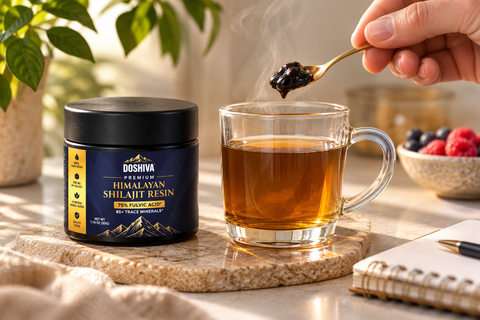
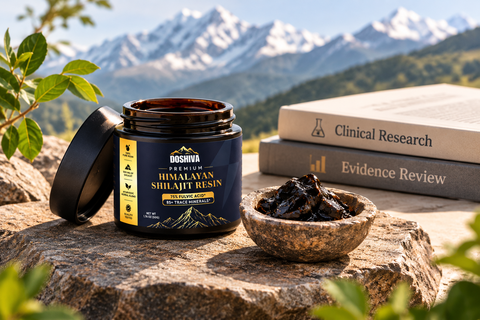
Doshiva Shilajit Resin states 50% fulvic acid and 84+ trace minerals, sourced in Gilgit-Baltistan at 16,000 to 18,000 feet, and heavy-metal tested by Eurofins. Each daily serving is 600 mg: 500 mg of shilajit resin plus a 100 mg herbal blend. Hold us to the same standard as everyone else. If you want to know how our figure was measured, ask us.
Our opinion is plain: a fulvic acid percentage is a starting point for questions, not a reason to buy. The lab report is the reason to buy.
If you are new to resin, our guide on how to take shilajit covers the serving, the method and the routine.
Fulvic acid vs humic acid in shilajit
Shilajit labels sometimes list humic acid next to fulvic acid, and the two are easy to confuse. Both are humic substances formed as plant matter decomposes. The practical differences for a buyer are simple:
| Fulvic acid | Humic acid | |
|---|---|---|
| What it is | Smaller, lighter humic fraction | Larger, heavier humic fraction |
| In water | Dissolves readily | Dissolves less readily |
| On shilajit labels | Usually the headline figure | Sometimes listed, often not |
Neither figure tells you about purity or heavy metals. A label that lists both is more transparent than one that lists neither, but the test method still matters for each number.
Fulvic acid in resin vs standalone fulvic acid supplements
Standalone fulvic acid drops and powders are usually made from other humic sources, such as ancient plant deposits, rather than shilajit. They can carry a high fulvic acid figure without containing any shilajit at all. If shilajit is what you want, check that the label names shilajit as the ingredient, not just fulvic acid.
Frequently asked questions
How much fulvic acid should shilajit have?
There is no agreed figure, because test methods differ. Compare products only when they state the same method, and look at milligrams per serving, not just the percentage.
Is fulvic acid the same as shilajit?
No. Fulvic acid is one component of shilajit. Standalone fulvic acid products are often made from other humic sources.
Why is fulvic acid lower in resin than in capsules?
Capsule extracts are concentrated during processing. Resin keeps more of the original material, so the fulvic acid share per gram is usually lower.
Does a higher fulvic acid percentage mean better quality?
Not on its own. Quality also means the right identity, the right processing and clean heavy-metal results, which a percentage does not show.
What does 50% fulvic acid mean on a label?
It means half the product's weight was measured as fulvic acid by the method the brand used. Ask which method, because results vary between methods.
Is fulvic acid safe?
Fulvic acid is a normal component of shilajit. The bigger safety question for any shilajit product is purity, especially heavy metals, which a fulvic acid figure does not tell you about. Ask for the batch heavy-metal report.
Can I take fulvic acid drops and shilajit together?
Check both labels and ask a pharmacist first, especially if you take medication. Avoid stacking several products with overlapping ingredients, and stay within each label.
Pair with: Doshiva Shilajit Resin, Energy & Vitality, All Doshiva products, How to take shilajit
Sources
- www.consumerlab.com/news/shilajit-supplements-found-to-contain-high-amounts-of-fulvic-a... (consumerlab.com)
- pmc.ncbi.nlm.nih.gov/articles/PMC3296184/ (pmc.ncbi.nlm.nih.gov)
- pubmed.ncbi.nlm.nih.gov/23733436/ (pubmed.ncbi.nlm.nih.gov)
This article is for information only and is not medical advice. Food supplements should not be used as a substitute for a varied, balanced diet and a healthy lifestyle. Speak to your doctor before taking supplements if you are pregnant, breastfeeding, take medication or have a medical condition.