Shilajit benefits: what the research actually shows, and what it doesn't
What shilajit is, what small human studies have actually tested, the side effects, and why purity matters more than any list of benefits.

A plain reading of the evidence, from people who sell the stuff and would rather you trust us than believe us.
Shilajit benefits are mostly promising rather than proven. Shilajit is a mineral-rich resin from high mountain rock, used in Ayurveda for centuries and rich in fulvic acid and trace minerals. Small human studies have looked at physical fatigue and healthy ageing, but the evidence is early, and no health claim for shilajit is approved in the EU. If you try it, choose purified, heavy-metal tested resin and treat it as a daily ritual, not a fix.
Search for shilajit benefits and you will find lists of ten, eleven, sometimes twenty. Most of them read the same way. A small study becomes a headline, a test-tube result becomes a promise, and the word "may" quietly disappears. This guide does the opposite. We go through what shilajit is, what has actually been tested in people, what the side effects are, and what to check before you buy any jar, including ours.
What shilajit is, and what's in it
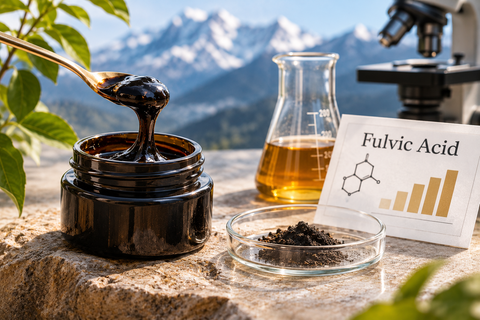
Shilajit is a dark, sticky resin that seeps from rock in high mountain ranges, the Himalayas above all. It forms over centuries as plant matter breaks down and is pressed between layers of stone. Raw, it looks like tar. Purified, it becomes the glossy resin sold in jars.
Its makeup is the reason people are interested. The main active compound researchers point to is fulvic acid, an organic acid formed as plants decompose. Alongside it come humic substances and a wide spread of trace minerals, including iron, magnesium and zinc. A 2012 review in the International Journal of Alzheimer's Disease described shilajit as a "phytocomplex" and named fulvic acid as its main active principle (Carrasco-Gallardo et al., 2012).
Composition varies a lot. Altitude, region, season and processing all change what ends up in the jar. That is why two products sold under the same name can be very different things. Shilajit also goes by other names, mumijo in Central Asia among them. We cover that history in what mumijo is and how it was used.
What studies have tested so far
Here is the honest state of the research. Most of it is small. Much of it was done in cells or animals. And a good share of the human trials used one branded, purified extract, often with funding from its maker. None of that makes the results worthless. It does mean "shown in one 8-week trial of 63 men" is a more accurate sentence than "boosts strength".
| Area studied | Type of evidence | What it found | How much weight to give it |
|---|---|---|---|
| Physical fatigue | Human trial, 63 men, 8 weeks | 500 mg a day: less strength loss after fatigue | Small, single trial, part industry-funded |
| Composition and fulvic acid | Review of earlier research | Describes fulvic acid as main active compound | Background, not proof of effect |
| Healthy ageing, antioxidant activity | Mostly lab and animal studies | Antioxidant activity in lab settings | Early; not shown in people |
| Stress, mood, sleep | Very little human data | Linked mainly to its magnesium content | Speculative |
The fatigue study, in detail
The most careful human trial most articles lean on is Keller et al., 2019, in the Journal of the International Society of Sports Nutrition. Sixty-three recreationally active men took either a placebo, 250 mg, or 500 mg of a purified shilajit extract daily for eight weeks. They then did a fatiguing leg exercise.
After fatigue, the 500 mg group lost about 9% of maximal strength. The low-dose and placebo groups lost about 16 to 17%. The low dose did no better than placebo. The authors themselves wrote that human research on shilajit is limited and called for more. The study was funded in part by the extract's manufacturer.
That is a real, interesting result. It is also one trial, in young men, using one specific extract, measuring one thing. Treat it as a reason for curiosity, not a promise.
What the lists leave out
Many benefits pages go much further: hormones, fertility, memory, bone health, iron levels. We have chosen not to repeat those here. Some rest on very small or very old studies. Others come from lab work that has never been tested in people. Cleveland Clinic's own review describes the evidence for most of these uses as small, preliminary, or from test tubes and animals (Cleveland Clinic). We would rather undersell.
Traditional uses in Ayurveda
Shilajit has a long place in Ayurveda, the traditional medicine of India. Classical texts treat it as a rasayana, a substance taken to support vitality and long life. It was usually prepared with other herbs and taken in small amounts over long periods.
Tradition is worth knowing. It tells you how people used shilajit for generations and why it is respected. It is not the same as evidence. Centuries of use show that something was valued, not what it does in the body. Keep the two apart and the subject becomes much easier to read.
Taking it every day: what to expect
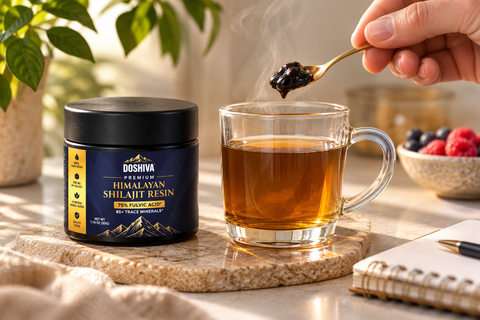
People who take shilajit usually take it daily, in a small amount, as part of a morning routine. A pea-sized portion of resin dissolved in warm water or tea is the classic way. It tastes earthy and slightly bitter, a little smoky. Not unpleasant. Not candy either.
What should you expect? Honestly, we can't tell you. There is no evidence-based timeframe for noticing anything, and anyone who gives you one is guessing. The trial above ran for eight weeks. Some people describe a ritual they enjoy and keep. Others notice nothing and stop. Both are normal outcomes.
If you want to try it, Doshiva Shilajit Resin comes in 50 g jars: one for EUR 49.95, two for 89.95, three for 109.95 and five for 124.95. Follow the serving on the label and don't take more to "speed things up". More is not better with a mineral-dense product.
Side effects and who should avoid it
Shilajit is generally well tolerated in short studies, but side effects are reported. Cleveland Clinic lists sore throat, headache, dizziness, nausea and diarrhoea among them, plus allergic reactions, as with any supplement. Stop taking it if any of these appear.
Some people should skip it or speak to a doctor first:
- Pregnant or breastfeeding women, and anyone trying to conceive
- Children
- People with heart conditions, blood pressure problems, or on blood thinners
- People with diabetes, or liver or kidney disease
- People with autoimmune conditions
- People with iron overload (haemochromatosis), since shilajit contains iron
Shilajit can also affect hormone levels, which in women may show up as skin or cycle changes. If you take prescription medication, check with your doctor or pharmacist before adding it. This is a food supplement, not a replacement for a varied diet or for medical care.
Why purity matters more than the benefits list
Here is the one point every serious source agrees on. Raw or poorly processed shilajit can contain heavy metals, such as lead, arsenic and mercury, along with fungi. Composition changes from batch to batch.
Our view is simple. Most "benefits" lists overstate small studies. The thing worth being strict about is purity. If a brand can't show you an independent heavy-metal test, don't buy it. Ours included.
What to ask for before you buy:
- An independent lab report for heavy metals, from a named lab
- The fulvic acid percentage, stated on the label
- Where it comes from and how it was purified
- Resin form if you want to see and smell what you're buying
Doshiva's purified Himalayan resin is Eurofins heavy-metal tested and states 70% fulvic acid and 84+ trace minerals on its product page. If you're still deciding on a format, our guide to resin vs gummies vs capsules compares them side by side.
Frequently asked questions
What does shilajit do to a woman?
The composition is the same for everyone. Most human trials were small and many included only men, so no benefit specific to women has been established. Women who are pregnant, breastfeeding or trying to conceive should avoid it.
Does shilajit reduce belly fat?
There is no good evidence that it does. We'd be wary of any product that says otherwise.
What's better, ashwagandha or shilajit?
They are different things. Ashwagandha is a root; shilajit is a mineral resin. They have separate, limited bodies of research, and neither is "better" in general. Some people take both. Check with a doctor if you take medication.
How long does it take to notice anything?
There's no evidence-based answer. The most-cited human trial ran for eight weeks, which says how long it was studied, not how long it takes to work.
Resin, gummies or capsules?
Resin is the least processed form. Doshiva® Gummies – Himalayan Shilajit (EUR 34.95) suit people who dislike the taste. The full comparison is in our format guide.
How do I know my shilajit is real and clean?
Ask for a batch lab report covering heavy metals from an independent lab. Real resin softens with warmth and hardens when cold, but texture tells you nothing about contaminants. Only a test does.
Pair with: Energy & Vitality, All Doshiva products
Sources
- pmc.ncbi.nlm.nih.gov/articles/PMC6364418/ (pmc.ncbi.nlm.nih.gov)
- pmc.ncbi.nlm.nih.gov/articles/PMC3296184/ (pmc.ncbi.nlm.nih.gov)
- health.clevelandclinic.org/shilajit-benefits (health.clevelandclinic.org)
This article is for information only and is not medical advice. Food supplements should not be used as a substitute for a varied, balanced diet and a healthy lifestyle. Speak to your doctor before taking supplements if you are pregnant, breastfeeding, take medication or have a medical condition.